Collingwood Sailors and Soldiers Memorial Hall, Abbotsford Pollen Forecast - Today, Tomorrow and the Week Ahead
Pollen Today
Today (10 October) pollen in Collingwood Sailors and Soldiers Memorial Hall, Abbotsford is low; cypress is low.
Pollen Tomorrow
Tomorrow (11 October 2026) cypress remains low, acacia at low levels.
7-Day Trend
Over the next week acacia, cypress, eucalyptus, and grass will increase.
Explore Forecasts
Get More in Our App
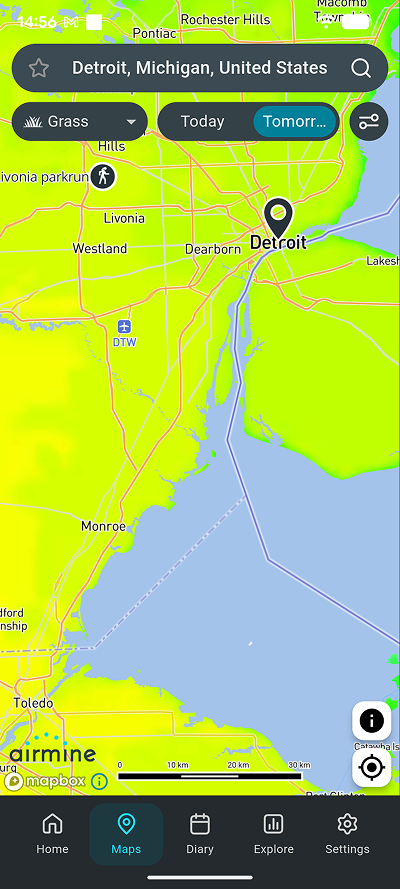
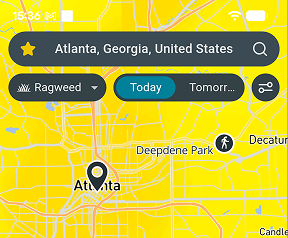
Local pollen and air quality forecasts, interactive pollen maps and route profiles


Features and forecast availability vary by region.
Pollen Risk
Today - 10 October
| Pollen species | Level | Value |
|---|---|---|
| Acacia (Acacia) | None | 0/100 |
| Cypress (Cupressaceae) | Low | 8/100 |
| Eucalyptus (Myrtaceae) | None | 0/100 |
| Grass (Poaceae) | None | 0/100 |
Tomorrow - 11 October
| Pollen species | Level | Value | 7-Day Trend |
|---|---|---|---|
| Acacia (Acacia) | Low | 3/100 | |
| Cypress (Cupressaceae) | Low | 11/100 | |
| Eucalyptus (Myrtaceae) | None | 0/100 | |
| Grass (Poaceae) | None | 0/100 |
Local Environmental Conditions
The landscape around this location in Abbotsford is densely built up, with some woodland. Close to running water, riverside trees such as plane tree contribute to what is in the air. Oak heads the list of allergenic trees nearby, ahead of plane tree. Beyond the trees, grasses matter a great deal, and pigweed and plantain are the main weed sources.
Tree pollen peaks in mid-spring, when the weather warms to around 15°C and oak and plane tree are in full flower. Grasses take over in early summer, with temperatures around 20°C, and their pollen lingers into early fall. The season closes with pigweed and plantain from early summer into early fall. Rain is heaviest in spring, often giving short breaks from high pollen levels.
Get pollen & AQ on Strava
Follow your environmental exposure and performance with the free Airmine-Strava integration. See your pollen and air quality exposure for every Strava activity.
Resource Hub
Pollen forecast neighborhoods 2 neighborhoods
Frequently Asked Questions About Pollen in Victoria
Is pollen high in Abbotsford right now?
On 10 October 2026, overall pollen levels in Abbotsford are low. Cypress is the main contributor to airborne pollen
Will pollen levels change in Abbotsford tomorrow?
On 11 October 2026, pollen conditions in Abbotsford will be different from today, with acacia at low levels, cypress at low levels
Is pollen expected to decrease in Abbotsford this week?
According to the five-day outlook, acacia, cypress, myrtle, and grass pollen levels will increase later in the week.
Which pollen types are currently active in Abbotsford?
On 10 October 2026, Cypress is the dominant pollen source in Abbotsford. acacia, myrtle, and grass are not currently active.
When is pollen season in Abbotsford?
How often is the Abbotsford pollen forecast updated?
The Abbotsford pollen forecast is updated four times daily. See the timestamp below for the most recent update.
Does pollen in Abbotsford come from nearby or far away?
Studies show that most pollen exposure (often 70–90%) comes from nearby sources, such as local trees and vegetation. A good pollen forecast therefore depends on accurately representing local vegetation. Pollen can travel long distances, but this usually matters only early in the season or during specific wind events.
Are pollen levels in Abbotsford based on measurements or forecasts?
Pollen data is often misunderstood. Most "pollen levels" are not real-time measurements, but forecasts.
Direct pollen measurements are typically delayed by 1-2 days because they require manual analysis. To show current conditions in Abbotsford, modern forecasts combine recent measurements, weather data, and information about local vegetation.
This allows us to estimate pollen levels for today and the coming days, not just report the past.
Airmine’s atmospheric monitoring platform was developed with support from the European Space Agency (ESA)’s Business Applications and Space Solutions (BASS) team, using satellite and Earth observation technologies to improve emissions monitoring.
Understanding the Scale
The 0–100 pollen scores represent risk levels, not direct pollen measurements. Higher scores indicate higher risk.
Pollen
| None | 0 | No or negligible risk of exposure. Pollen/mold exposure is expected to be minimal. |
| Low | 0-25 | Low risk of exposure. Small amounts of pollen or mold spores may be present. |
| Moderate | 25-50 | Moderate risk of exposure. Pollen/mold exposure is expected to be noticeable. |
| High | 50-75 | High risk of exposure. Elevated pollen/mold exposure is expected. |
| Very High | 75-100 | Very high risk of exposure. Pollen/mold exposure is expected to be at or near its highest levels. |
Get More in the Airmine Pollen app
Get 15-day pollen forecasts with morning, afternoon and evening detail, plus 5-day air quality forecasts. Explore interactive pollen risk maps, estimated pollen season start, route profiles and a symptoms diary.
Features and forecast availability vary by region. Currently covering Europe, the contiguous US, southern Canada, South Africa, Australia, Indonesia (Java & Bali), Brazil, Paraguay, Uruguay and the Buenos Aires area.
Developed with support from the European Space Agency (ESA) Business Applications and Space Solutions (BASS).