Ivywild, Colorado Springs Mold Forecast - Today, Tomorrow and the Week Ahead

Mold Today

Low 25/100

Today (10 October) mold in Ivywild, Colorado Springs is low; alternaria and cladosporium are low.

Mold Tomorrow

Low 23/100

Tomorrow (11 October 2026) levels are similar to today.

7-Day Trend

Over the next week alternaria and cladosporium will decrease.

Updated: 11 October 2026 at 03:11 CEST
Country: United States

Explore Forecasts

Mold Forecast for Neighborhoods

57 neighborhoods in Colorado Springs

All Souls Unitarian Universalist Church Mold today Mold tomorrow American Numismatic & Money Museum Mold today Mold tomorrow Blondie's Mold today Mold tomorrow Boulder Street Gallery and Framing Mold today Mold tomorrow Chadbourn Spanish Gospel Mission Mold today Mold tomorrow Club Room Fitness Mold today Mold tomorrow Colorado Springs City Hall Mold today Mold tomorrow Colorado Springs Fine Arts Center Mold today Mold tomorrow Colorado Springs Pioneers Museum Mold today Mold tomorrow Continuum — the Julie Penrose Fountain Mold today Mold tomorrow Cragmor Mold today Mold tomorrow Dale Street Cafe Mold today Mold tomorrow Downtown Executive Center Mold today Mold tomorrow First Baptist Church of Colorado Springs Mold today Mold tomorrow First Christian Church Mold today Mold tomorrow First Church of Christ, Scientist Mold today Mold tomorrow First United Methodist Church Mold today Mold tomorrow Foot of the Rockies RV Resort Mold today Mold tomorrow Garden of the Gods Mold today Mold tomorrow Garden of the Gods RV Resort Mold today Mold tomorrow General William J. Palmer High School Mold today Mold tomorrow Ghost Town Wild West Museum Mold today Mold tomorrow Glen Eyrie Mold today Mold tomorrow Grace and St. Stephen's Episcopal Church Mold today Mold tomorrow IAFF Fallen Fire Fighter Memorial Mold today Mold tomorrow Illegal Pete's Mold today Mold tomorrow Ivywild Mold today Mold tomorrow Jack Quinn's Irish Alehouse and Pub Mold today Mold tomorrow Law Offices Mold today Mold tomorrow LGM-30G Minuteman III Mold today Mold tomorrow McAllister House Museum Mold today Mold tomorrow MIM-14 Nike Hercules Mold today Mold tomorrow MIM-23 HAWK Mold today Mold tomorrow National Museum of World War II Aviation Mold today Mold tomorrow Navajo Hogan Mold today Mold tomorrow New Covenant Church of God in Christ Mold today Mold tomorrow Old Colorado City Mold today Mold tomorrow Old Colorado City History Center Museum Mold today Mold tomorrow Penrose Heritage Museum Mold today Mold tomorrow Peterson Air and Space Museum Mold today Mold tomorrow Pikes Peak Mold today Mold tomorrow Pikes Peak Association of Realtors Mold today Mold tomorrow Pikes Peak Range Riders Memorial Mold today Mold tomorrow Popcycle Bridge Mold today Mold tomorrow Ritz Grill Mold today Mold tomorrow Rock Ledge Ranch Historic Site Mold today Mold tomorrow Rocky Mountain Motorcycle Museum Mold today Mold tomorrow Ronald McDonald House Mold today Mold tomorrow Roswell Mold today Mold tomorrow Rutledge's Mold today Mold tomorrow Saint George's Anglican Church Mold today Mold tomorrow Space Foundation Discovery Center Mold today Mold tomorrow St. Mary's Inn Mold today Mold tomorrow U.S. Olympic and Paralympic Museum Mold today Mold tomorrow Van Briggle Building Mold today Mold tomorrow Victory Ridge Mold today Mold tomorrow World Figure Skating Museum Mold today Mold tomorrow

Get More in Our App

Local pollen and air quality forecasts, interactive pollen maps and route profiles

Download on the App Store Get it on Google Play

Features and forecast availability vary by region.
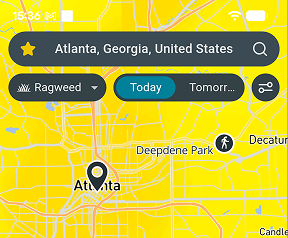
Airmine app pollen map

Mold Risk

Today - 10 October

Mold species Level Value
Alternaria
Low
15/100
Cladosporium
Low
25/100

Tomorrow - 11 October

Mold species Level Value 7-Day Trend
Alternaria
Low
13/100
Cladosporium
Low
23/100
ENVIRONMENT & ANALYSIS

Local Mold Conditions

The area around this part of Colorado Springs offers a fair amount of plant material that mold can grow on, mainly in the green spaces among the buildings. Within the built-up area, mold finds food in compost heaps, mulched beds, grass clippings and leaves gathered along streets and gutters. Banks and low ground beside a stream or river stay wet enough for plant debris to break down quickly.

Cladosporium, the most common outdoor mold, grows on fallen leaves and dead wood from May to September, peaking in July when temperatures average about 21°C. Alternaria follows a warmer pattern, rising from June to September and peaking in July. From November to March, temperatures below 5°C keep both molds at very low levels. Day to day, spores peak on dry, breezy afternoons after dew or light rain.

Get pollen & AQ on Strava

Follow your environmental exposure and performance with the free Airmine-Strava integration. See your pollen and air quality exposure for every Strava activity.

Resource Hub

Pollen forecasts for Colorado Springs Air quality for Colorado Springs
Mold forecast neighborhoods 57 neighborhoods
All Souls Unitarian Universalist Church
Mold today Mold tomorrow
American Numismatic & Money Museum
Mold today Mold tomorrow
Blondie's
Mold today Mold tomorrow
Boulder Street Gallery and Framing
Mold today Mold tomorrow
Chadbourn Spanish Gospel Mission
Mold today Mold tomorrow
Sports venues in Colorado Springs 1 sports venue

Frequently Asked Questions About Mold in Colorado

Why do I still have allergy symptoms after the pollen season?

Allergy symptoms after the main pollen season may be caused by mold spores. Outdoor mold levels can remain high into late summer and autumn, when pollen levels are already falling. Mold allergy can cause symptoms similar to pollen allergy, including sneezing, a runny or blocked nose, itchy eyes, coughing, and wheezing.

What are mold spores and why do they cause allergies?

Mold spores are tiny particles released by fungi into the air. When inhaled, they can trigger an allergic reaction in sensitive people. Common symptoms include sneezing, a runny or blocked nose, itchy or watery eyes, coughing, and wheezing.

When are mold spore levels highest?

Outdoor mold spore levels often increase during warm and humid conditions, particularly when there is plenty of decaying vegetation. Levels can vary considerably with weather, season, vegetation, and location, and some types of mold are more common during particular times of the year, e.g. in the Fall.

How can I reduce my exposure to mold spores?

If you are sensitive to mold, check local mold spore levels and forecasts before spending long periods outdoors. On high-risk days, reducing time around dense vegetation, compost, fallen leaves, and other sources of decaying plant material may help limit exposure.

Understanding the Scale

The 0–100 mold scores represent risk levels, not direct mold measurements. Higher scores indicate higher risk.

Mold

None
0 No or negligible risk of exposure. Pollen/mold exposure is expected to be minimal.
Low
0-25 Low risk of exposure. Small amounts of pollen or mold spores may be present.
Moderate
25-50 Moderate risk of exposure. Pollen/mold exposure is expected to be noticeable.
High
50-75 High risk of exposure. Elevated pollen/mold exposure is expected.
Very High
75-100 Very high risk of exposure. Pollen/mold exposure is expected to be at or near its highest levels.

Get More in the Airmine Pollen app

Get 15-day pollen forecasts with morning, afternoon and evening detail, plus 5-day air quality forecasts. Explore interactive pollen risk maps, estimated pollen season start, route profiles and a symptoms diary.

Features and forecast availability vary by region. Currently covering Europe, the contiguous US, southern Canada, South Africa, Australia, Indonesia (Java & Bali), Brazil, Paraguay, Uruguay and the Buenos Aires area.

Developed with support from the European Space Agency (ESA) Business Applications and Space Solutions (BASS).
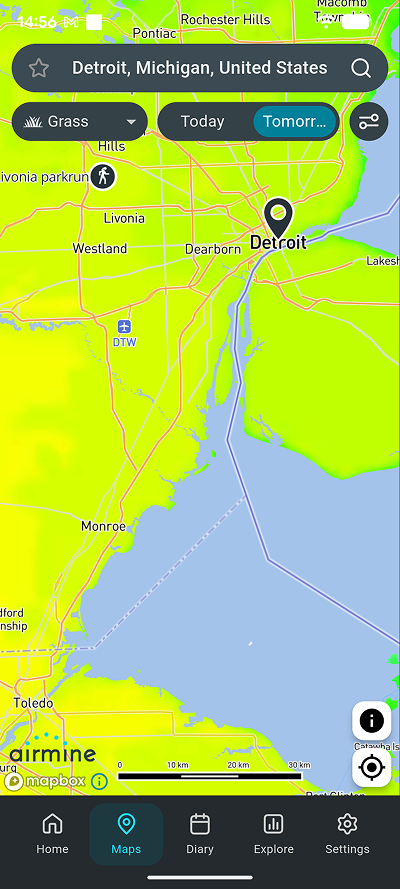
Airmine app pollen map

Airmine’s atmospheric monitoring platform was developed with support from the European Space Agency (ESA)’s Business Applications and Space Solutions (BASS) team, using satellite and Earth observation technologies to improve emissions monitoring. This page provides the latest mold spore forecast for Ivywild, Colorado Springs.

Data provided by Airmine — Last update: 11 October 2026 at 03:11 CEST

Methodology & Technology

Airmine combines satellite observations, weather forecasts and machine learning to forecast pollen, air quality and mold risk. For pollen, vegetation maps and weather data help predict season onset and exposure at 400 × 400 metre resolution. For air quality, we refine Copernicus CAMS forecasts using local factors such as roads, emissions and terrain. For routes, data is updated dynamically to provide accurate exposure metrics along the specific race corridor coordinates.

Our models are calibrated against millions of professional monitoring records and updated four times daily as new data becomes available.

Unless stated otherwise, this content is Airmine’s sole responsibility and has not been paid for by external organisations.

Disclaimer

The information provided is for environmental awareness only and does not constitute medical advice. Athletes with known respiratory conditions or severe allergies should consult their physician before participating in strenuous outdoor activities based on these forecasts.

Some text on this page may be generated or summarised using artificial intelligence (AI). Wherever possible, AI-generated content is enriched with Airmine's proprietary data to improve its accuracy and relevance. However, AI-generated content may still contain errors, omissions, or inaccuracies.