United States Holocaust Memorial Museum, Washington Air Quality Forecast - Today, Tomorrow
Air Quality Today
Today (10 October): Air quality in United States Holocaust Memorial Museum is fair. AQI, NO2, and O3 are fair; PM2.5, PM10, SO2, CO, HCHO, and PM1 are good. Pollution peaks around 12:00 PM (O3: 26.2/100).
Air Quality Tomorrow
Tomorrow (11 October 2026): Air quality in United States Holocaust Memorial Museum is fair. PM2.5 increases to fair; all other pollutants stay as today. Pollution peaks around 12:00 PM (O3: 28.8/100).
Explore Forecasts
Get More in Our App
Local pollen and air quality forecasts, interactive pollen maps and route profiles


Features and forecast availability vary by region.
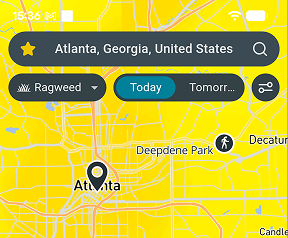
Air Quality
Today - 10 October
| Pollutant | Level | Value |
|---|---|---|
| AQI | Fair | 26.2/100 |
| PM2.5 (fine particles) | Good | 18.9/100 |
| PM10 (coarse particles) | Good | 10.0/100 |
| NO2 (nitrogen dioxide) | Fair | 20.6/100 |
| O3 (ozone) | Fair | 26.2/100 |
| SO2 (sulfur dioxide) | Good | 1.4/100 |
| CO (carbon monoxide) | Good | 0.6/100 |
| HCHO (formaldehyde) | Good | 3.7/100 |
| PM1 (ultrafine particles) | Good | 11.4/100 |
Tomorrow - 11 October
| Pollutant | Level | Value |
|---|---|---|
| AQI | Fair | 28.8/100 |
| PM2.5 (fine particles) | Fair | 23.0/100 |
| PM10 (coarse particles) | Good | 13.9/100 |
| NO2 (nitrogen dioxide) | Fair | 21.5/100 |
| O3 (ozone) | Fair | 28.8/100 |
| SO2 (sulfur dioxide) | Good | 1.7/100 |
| CO (carbon monoxide) | Good | 0.6/100 |
| HCHO (formaldehyde) | Good | 5.0/100 |
| PM1 (ultrafine particles) | Good | 13.6/100 |
Local Environmental Conditions
Around this site in Washington, a mix of built-up land and open space means traffic is an important, but not overwhelming, local pollution source. Home heating, especially wood stoves and fireplaces, adds smoke and fine particles in the colder months. Pockets of trees and green space help filter a small share of the particles from traffic. On some days, pollution drifting in from farther away outweighs local sources.
Particle levels tend to be highest from December to March, when home heating and traffic add more emissions and cold, calm spells at around 3°C slow their dispersal. By contrast, hot afternoons from June to September, averaging 27°C in the warmest month, are when ozone is most likely to build up. March is usually the windiest month, averaging about 20 km/h, which helps keep the air clean.
Get pollen & AQ on Strava
Follow your environmental exposure and performance with the free Airmine-Strava integration. See your pollen and air quality exposure for every Strava activity.
Resource Hub
Air quality forecast neighborhoods 29 neighborhoods
Sports venues in Washington 1 sports venue
Frequently Asked Questions About Air Quality in District of Columbia
Is air quality bad in United States Holocaust Memorial Museum right now?
On 10 October 2026, overall air quality in United States Holocaust Memorial Museum is fair. AQI is the main air quality indicator at 26.2/100. Pollution peaks around 12:00 PM (O3: 26.2/100).
Will air quality be worse tomorrow in United States Holocaust Memorial Museum?
On 11 October 2026, air quality conditions in United States Holocaust Memorial Museum will be similar to today, with AQI forecast at fair at 28.8/100. Pollution peaks around 12:00 PM (O3: 28.8/100).
When is air pollution at its worst in United States Holocaust Memorial Museum?
Particle levels tend to be highest from December to March, when home heating and traffic add more emissions and cold, calm spells at around 3°C slow their dispersal. By contrast, hot afternoons from June to September, averaging 27°C in the warmest month, are when ozone is most likely to build up. March is usually the windiest month, averaging about 20 km/h, which helps keep the air clean.
Are air quality levels in United States Holocaust Memorial Museum based on measurements or forecasts?
It is forecasts derived by downscaling forecasts provided by EU’s Copernicus Atmosphere Monitoring Service (CAMS) by taking into account local conditions such as traffic patterns. CAMS bases its forecast on satellite measurements of particles and chemical compounds in the atmosphere. Airmine’s services were developed with support from the European Space Agency (ESA)’s Business Applications and Space Solutions (BASS) team.
Why doesn’t the forecast always reflect wildfire impacts?
Airmine’s forecast uses CAMS (Copernicus Atmosphere Monitoring Service) as its background atmospheric model. While CAMS includes wildfire emissions, these are derived from satellite observations and are not available in real time. During rapidly evolving wildfire events, there may therefore be a delay before increased emissions are incorporated into the model. As a result, the forecast may temporarily underestimate PM₂.₅ and other pollutants associated with wildfire smoke.
During rapidly evolving wildfire events, CAMS may lag by approximately 1–2 days before increased wildfire emissions are fully represented, which can lead to temporary underestimation of PM₂.₅ concentrations in Airmine’s forecast.
Understanding the Scale
The 0–100 air quality scores represent risk levels, not direct air pollutant concentrations. Higher scores indicate higher risk.
Air Quality
| Good | 0-20 | Low air quality risk. Air quality is expected to be good, with low levels of pollution. |
| Fair | 20-40 | Generally low air quality risk. Air quality is expected to be acceptable, with some pollution present. |
| Moderate | 40-60 | Moderate air quality risk. Air pollution is elevated and air quality may be less favorable. |
| Poor | 60-80 | High air quality risk. Air pollution is high and air quality is expected to be poor. |
| Very Poor | 80-100 | Very high air quality risk. Air pollution is very high and air quality is expected to be very poor. |