Chicago Marathon - Pollen and Air Quality Forecast for Today
Pollen Today
Pollen levels are low today, with ragweed, grass, and mugwort as the main active species. Based on Airmine's forecast, which uses satellite data to calculate exposure every 200 metres along the route, pollen exposure peaks at 21.4 km after start.
Air Quality Today
Air quality along the route is good, with all pollutants at low levels. Based on Airmine's forecast, which uses satellite data to calculate exposure every 200 metres along the route, air quality is at its worst 10.4 km after start.
Route Map
Loading route map…
Environmental Exposure Detail
One of the seven Abbott World Marathon Majors, the Chicago Marathon is famous for its flat, fast loop through 29 city neighborhoods. Starting and finishing in Grant Park, it has produced multiple world records thanks to its minimal elevation change.
Around race day for Chicago Marathon in October, pollen levels are generally low, with occasional mould spore spikes in damp conditions. Cool conditions (around 13°C) tend to keep pollen release moderate, and frequent rain can help settle pollen, though the damp conditions also favour mould spores. As a mainly urban route, air pollution here is often worse on cold mornings, when traffic fumes get trapped near the ground, and on warm, still days, when ozone can build up — both affecting air quality more than pollen.
Get More in Our App
Local pollen and air quality forecasts, interactive pollen maps and route profiles


Features and forecast availability vary by region.
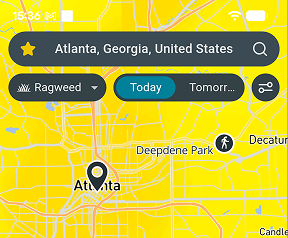
Forecast for 10 October
Pollen Forecast
| Pollen species | Level | Value |
|---|---|---|
| Alder (Alnus) | None | 0/100 |
| Birch (Betula) | None | 0/100 |
| Hazel (Corylus) | None | 0/100 |
| Cypress (Cupressaceae) | None | 0/100 |
| Grass (Poaceae) | Low | 8/100 |
| Oak (Quercus) | None | 0/100 |
| Willow (Salicaceae) | None | 0/100 |
| Mugwort (Artemisia) | Low | 6/100 |
| Ragweed (Ambrosia) | Low | 11/100 |
Air Quality Forecast
| Pollutant | Level | Value |
|---|---|---|
| AQI | Good | 9.5/100 |
| PM2.5 (fine particles) | Good | 9.1/100 |
| PM10 (coarse particles) | Good | 5.4/100 |
| NO2 (nitrogen dioxide) | Good | 8.1/100 |
| O3 (ozone) | Good | 9.4/100 |
| SO2 (sulfur dioxide) | Good | 0.3/100 |
| CO (carbon monoxide) | Good | 0.5/100 |
| HCHO (formaldehyde) | Good | 2.2/100 |
| PM1 (ultrafine particles) | Good | 2.9/100 |
Get pollen & AQ on Strava
Follow your environmental exposure and performance with the free Airmine-Strava integration. See your pollen and air quality exposure for every Strava activity.
Resource Hub
Popular Local Routes 4 routes
Frequently Asked Questions
Where is air quality worst on the Chicago Marathon route?
Based on today's forecast, O3 is forecast at good levels along the route today (9.4/100). Air quality is at its worst after 10.4 km into the route. Airmine calculates exposure at 200m intervals along the course using satellite-derived atmospheric data.
Where is pollen highest on the Chicago Marathon course?
Pollen exposure peaks at km 21.4 today. This changes through the season as different pollen species become active.
When is pollen worst during the Chicago Marathon season?
October coincides with peak ragweed season. Grass pollen typically rises in May-June.
How often is this forecast updated?
Updated four times daily. See the timestamp below for the most recent update.
Are pollen levels in Chicago Marathon based on measurements or forecasts?
Pollen data is often misunderstood. Most "pollen levels" are not real-time measurements, but forecasts.
Direct pollen measurements are typically delayed by 1-2 days because they require manual analysis. To show current conditions in Chicago Marathon, modern forecasts combine recent measurements, weather data, and information about local vegetation.
This allows us to estimate pollen levels for today and the coming days, not just report the past.
Airmine’s atmospheric monitoring platform was developed with support from the European Space Agency (ESA)’s Business Applications and Space Solutions (BASS) team, using satellite and Earth observation technologies to improve emissions monitoring.
Understanding the Scale
The 0–100 scores represent risk levels, not direct measurements of pollen or air pollutant concentrations. Higher scores indicate higher risk. Pollen and air quality use different thresholds.
Pollen
| None | 0 | No or negligible risk of exposure. Pollen/mold exposure is expected to be minimal. |
| Low | 0-25 | Low risk of exposure. Small amounts of pollen or mold spores may be present. |
| Moderate | 25-50 | Moderate risk of exposure. Pollen/mold exposure is expected to be noticeable. |
| High | 50-75 | High risk of exposure. Elevated pollen/mold exposure is expected. |
| Very High | 75-100 | Very high risk of exposure. Pollen/mold exposure is expected to be at or near its highest levels. |
Air Quality
| Good | 0-20 | Low air quality risk. Air quality is expected to be good, with low levels of pollution. |
| Fair | 20-40 | Generally low air quality risk. Air quality is expected to be acceptable, with some pollution present. |
| Moderate | 40-60 | Moderate air quality risk. Air pollution is elevated and air quality may be less favorable. |
| Poor | 60-80 | High air quality risk. Air pollution is high and air quality is expected to be poor. |
| Very Poor | 80-100 | Very high air quality risk. Air pollution is very high and air quality is expected to be very poor. |