
Same pandemic, different impact
For big cities with high levels of air pollution, such as Delhi, India, Covid-19 lockdown improved air quality drastically. Cities with low to moderate pollution levels, however, did not experience the same decline in air pollutants.
Delhi air significantly cleaner
Major cities in India have seen a clear improvement to air quality during this year's lockdowns due to the Covid-19 pandemic. The graph shows the reductions in Delhi. We see a big drop in PM2.5 levels after the first, quite strict, measures were enforced.
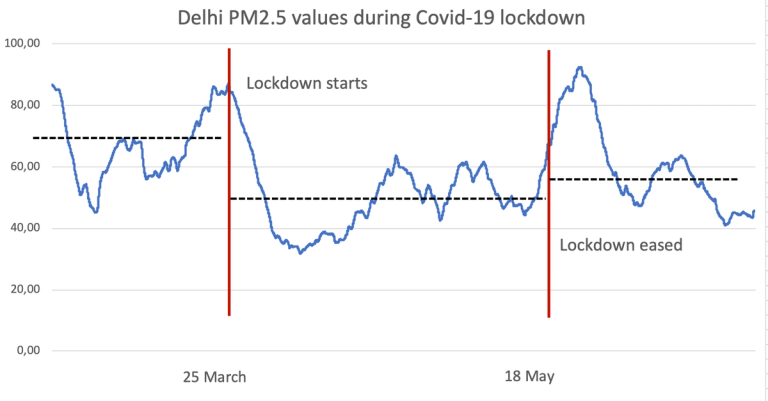
On April 15 Delhi eased its lockdown rules somewhat, entering the so-called Phase 2. Air pollution surged, but the increase came after the transition to Phase 4 May 18, as illustrated in the graph.
Our findings are backed by a recent study, where roughly 50% reduction in PM2.5 and PM10 levels are found after lockdown began. It is worth noticing that the PM2.5 levels are still above what is considered a healthy level (25 μg/m3 24-hour mean according to WHO and EEA).
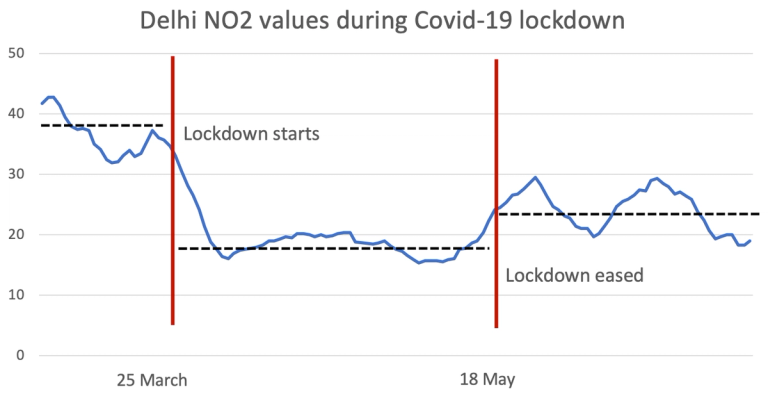
We see a similar pattern for the NO2-levels recorded in Delhi in the lockdown period, see the graph below.
PM2.5 levels in Oslo show little impact of lockdown
Delhi is huge and highly polluted, neither can be said of Norway's capital Oslo. However, the city struggles with relatively high levels of particulate matter, notably in winter and early spring. Road dust, fire stove heating and heavy traffic combined with little wind and high atmospheric pressure frequently produces PM values well above what is healthy.
In Oslo, this effect can clearly be seen in the graph below. The peak in end March stems from a combination of dry weather and dusty roads, see our post on the topic. We note no effect of the lockdown on the PM2.5 levels.
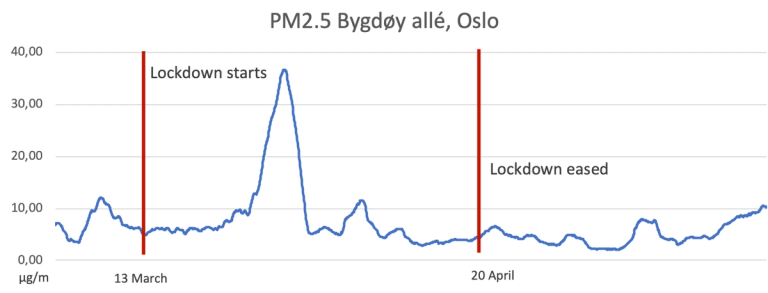
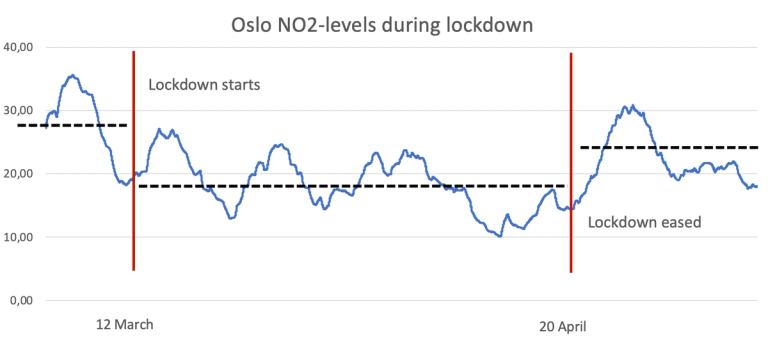
These findings are in line with studies on air quality during the Covid-19 lockdowns covering USA and major European cities. NO2 levels dropped during lockdown, but there is not necessarily a decline in particulate matter. As noted by the European Environment Agency, the sources of PM2.5 are varied and largely impacted by weather conditions and seasonal activities, such as agriculture.
Air pollution likely to increase Covid-19 mortality
Several studies indicate links between Covid-19 death rates and previous exposure to air pollution, notably fine particulate matter (PM2.5). For further reading see this preprint covering the US or this Dutch study.
The lockdown effects on society and people's lives are obviously largely negative, specially for the poorest citizens. However, we hope that the cleaner air following reduced human activity can inspire actions to improve air quality also in the future. The ongoing pandemic is showing us how important healthy air is.